Operational truth, not vendor hype.
- The operational reality of using Cloud-LLMs for InfraSec and AppSec work.
- Where AI is a brilliant assistant, and where it is artificially stupid or disobedient.
- Field notes from actual usage. American models (Claude from Anthropic). Open-weight Chinese models (DeepSeek).
- Reality vs the marketing hype of their vendors.
- How to reduce AI flaky behavior by separating deterministic checks from the ones that actually need AI thinking.
- How to manage cognitive debt and intent debt.
Who stays accountable at the end of day. (You do.)
Intermediate builders new or limited in AI adoption.
- Why them. Many experienced teams in big software companies are not as AI-embracing, or as AI-assessing, as other teams are. If that is your team, this is for you.
What the advice is sized for.
- Legacy systems.
- Multi-repository projects.
- Stakes higher than a local school project with no end users.
Ron Michael Diokno Khu.
Proud dad to my daughters. Software engineer by profession, and by passion.
Two decades, across domains.
- Telecom management systems
- Power plant operations
- Mobile aircraft navigation
- Web 3D technologies
- Imaging and printing drivers
- Healthcare platforms
- Attorney-client matching system
- IoT ecosystems
- Automated stock futures trading
- ...and more
Where the field notes come from.
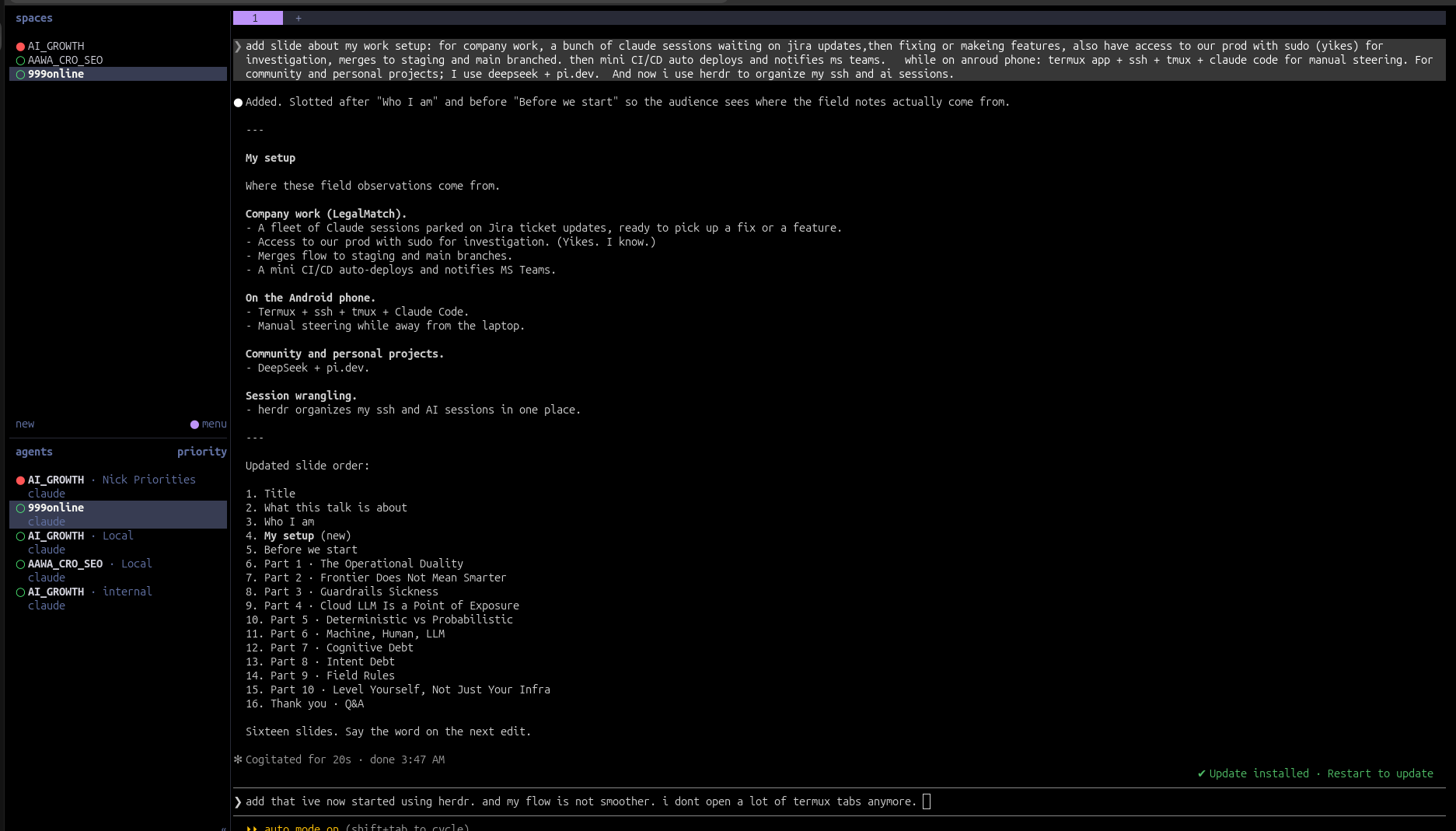
Company work (LegalMatch).
- Fleet of Claude sessions parked on Jira ticket updates.
- Prod access with sudo for investigation. (Yikes. I know.)
- Merges flow to staging and main branches.
- Mini CI/CD auto-deploys and notifies MS Teams.
Android phone.
- Termux + ssh + tmux + Claude Code.
- Manual steering while away from the laptop.
Community and personal.
- DeepSeek + pi.dev.
Session wrangling (new).
- Now using herdr to organize ssh and AI sessions in one place.
- Flow is now smoother. I do not open a lot of Termux tabs anymore.
How a ticket becomes production.
Every deploy pings MS Teams. herdr organizes the sessions. Phone + Termux + ssh + tmux for mobile steering.
Questions to hold while the talk runs.
- If the AI breaks it at 2am, who gets paged? You, or the vendor?
- Why does the newer "frontier" model feel dumber than the one you had last quarter?
- What percentage of your AI-assisted security code have you actually read, line by line?
- If your LLM vendor had a disgruntled insider tomorrow, what would they already know about your infra?
- Could a 5-line bash script do the check you are paying tokens for?
- Who is accountable when the AI confidently writes a wrong IAM policy?
Brilliant and artificially stupid, same session.
Brilliant
- Regex drafts
- Log triage summaries
- Scaffolding
- Docs digestion
Artificially stupid
- Hallucinated flags
- Invented CLI parameters
- Confidently wrong IAM
- Silent logic regressions
The human operator is accountable. End of day.
Newer release does not equal better.
- Field reality: regressions, dumbed-down tool use, over-restrictive refusals.
- Among advanced devs today, Claude is widely considered crippled. DeepSeek is still smarter for a lot of real work, and it is open-weight on top of that.
- Trusting marketing benchmarks leads to fragile pipelines.
Fair disclaimer. Rankings here are a snapshot, not a verdict.
- Can flip. Vendors ship, degrade, and ship again. Re-evaluate per quarter, not per keynote.
- Domain-shaped. Example: Claude builds JavaScript decks and can see its own render. DeepSeek has no vision API and must approximate layout from text alone.
- Takeaway. Match the model to the task. Keep two or three in rotation.
“Is this site secure?”
Months ago I tried the same prompt across several models.
| Posture | Immediate & literal (DeepSeek & friends) | Cautious & preachy (Claude) |
|---|---|---|
| Behavior | SQLi probes, parameter fuzzing, header manipulation. Starts working. | Tiptoes. Asks to confirm authorization. May refuse outright. |
| Good when | You own the box and want results fast. | You want a brake against legal or scope mistakes. |
| Bad when | Operator is sloppy or scope unclear. | Work is legitimately yours and model will not help. |
| Hidden cost | Legal exposure, blast radius. | Hours lost to jailbreak gymnastics. |
Not a smart vs dumb question. A workflow question. Pick the behavior that fits your workflow and your legal posture.
Safety guardrails that refuse legitimate security work.
- Examples. Refusing to parse a payload capture. Refusing to help on a log that contains PII you own. Refusing to touch an IAM policy because the prompt says "exploit."
- The hidden cost. Hours bled engineering jailbreaks for benign work.
Guardrails Sickness: a vendor-side disease the operator pays for.
You are letting software crawl your infra and tell its server.
Surface
- Terraform
- Security groups
- Network topology
- Proprietary logic
- Customer schemas
- Log excerpts
Threat actors
- The vendor itself (policy flips tomorrow)
- A disgruntled vendor insider
- Vendor supply-chain compromise
- Cross-tenant leaks
Threat-model it like you would any third-party contractor you cannot audit.
Never use an LLM for what a 5-line bash script can do.
Deterministic → script
- SSH open to the world?
- Service bound to
0.0.0.0when it should be127.0.0.1? - UFW rules match the intended security group?
- IAM JSON validates against a policy linter?
- TLS cert expiring in less than 30 days?
Probabilistic → LLM
- Correlating a multi-source log anomaly flow.
- Explaining a 300-line policy diff in plain English.
- Drafting an incident narrative from Slack, logs, and metrics.
The split removes flaky AI from load-bearing paths.
Who is good at what. And who pays.
| Axis | Deterministic script | Human | LLM |
|---|---|---|---|
| Cost | cheap, one-time | expensive, finite | cheap per call, drifts |
| Repeatability | perfect | bounded by fatigue | per-call variance |
| Exposure | none | contained | leaks code and infra outside |
| Accountability | the author | the human | still the human |
| Fails by | logic bug | missed detail | hallucination + confident wrong |
Accepting AI code you cannot defend.
- Symptom. Your repo passes checks nobody can defend in a code review.
- Compound interest. Six months later it breaks, and nobody on the team knows why that firewall rule exists.
Fix: AI explains. You understand. Then you ship.
What you meant vs what the AI shipped.
- Example 1. Asked for "block external access to admin." Got a rule that blocks external access, except for a hardcoded CIDR the AI invented.
- Example 2. Asked for "least privilege S3 policy." Got a wildcard permission with a comment that says
// least privilege. - Silent security gaps. The code reads right. The intent is wrong.
Fix: verify the enforcement, not the vibes.
Six rules for the operator.
- 1. Least privilege for AI agents. Treat an LLM service account like a junior contractor from a vendor you cannot audit.
- 2. Deterministic to scripts. Probabilistic to the LLM. Never swap.
- 3. Do not paste prod secrets, topology, or customer data into a cloud LLM. If you must send infra context, send a redacted shape.
- 4. For sensitive work, prefer open-weight models you host. You keep the weights. The data does not leave the box.
- 5. Same code-review bar as a dev's. No "it is just a quick fix" exceptions.
- 6. Verify the intent, not the vibes.
The real cost is the operator who stops learning.
- The real cost of AI-first operation is not tokens.
- Use the LLM as a learning amplifier. Ask it to teach you, not just do.
- Then you can audit it. Then you can disagree with it. Then you are actually accountable.
Build yourself up, not just your output.
Local and global. Participate in the discussions.
- Why it matters. No single operator tracks every model regression, every quiet nerf, every new attack vector. The field moves too fast for one person.
My own.
- AWS User Group Cebu
- PizzaPy
- IoT Cebu
- CeGNULUG (Cebu GNU/Linux Users Group)
Participate. Do not just lurk.
Share a field note. Ask the question. File the bug. Challenge the hype. The community gets smarter when operators show up and contribute what they are actually seeing.